Do You Need a Baby Monitor That Monitors Breathing
About Babies Don't Need Breathing Monitors
There's no real prove that consumer devices keep infants safer, and doctors say "peace of listen" isn't a good enough reason to purchase them.
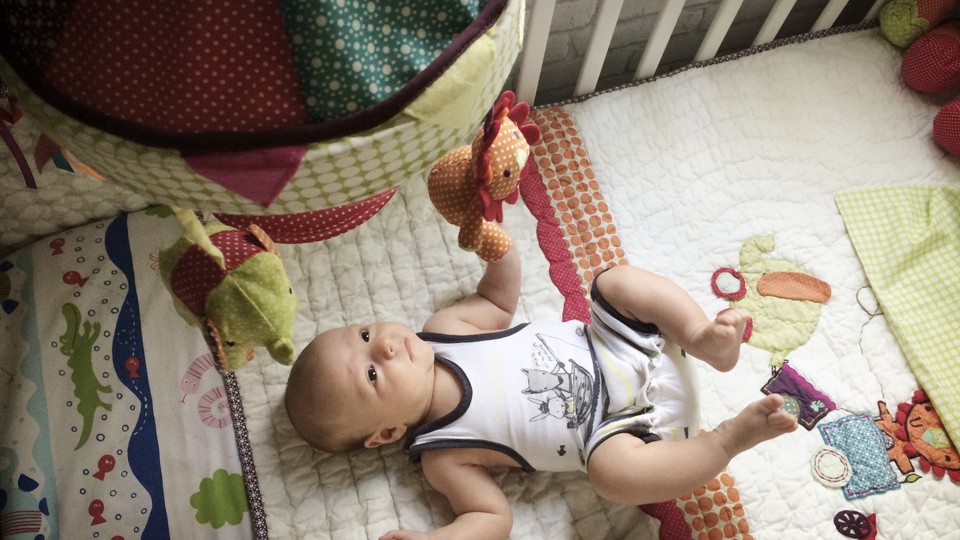
Parents of newborn babies are an easy target.
Beingness perpetually exhausted and overwhelmed makes a person way more likely to, say, trounce out $xxx on a single infant bottle, or fork over hundreds more for a fancy bluetooth-enabled swing.
Then there are the baby monitors. No longer is it enough to just hear ane's baby howling from the next room, with a walkie-talkie way audio monitor (or, for that matter, through the walls). These days, at that place's plenty technology out there for parents to create a Batcave-esque infant-surveillance command middle—built on live video feeds, vesture temperature trackers, animate and move monitors, and more.
But which of these devices, if any, really keep baby safer? And how are parents supposed to split the legitimately useful engineering from sensor-equipped snake oil?
Whether this level of attention is necessary, or fifty-fifty helpful, is perhaps a matter of personal preference. But like many questions in the realm of parenthood, it's also a source of much debate. "We transport parents habitation from the infirmary with a sail of paper to tape wet diapers and poopy diapers," says Lisa Asta, a pediatrician and a spokesperson for the American Academy of Pediatrics. "That piece of newspaper is useful for about three to five days, and afterward that, there really isn't whatsoever recommended technology." New guidelines from the American Academy of Pediatrics say that parents and infants should share a room (but non a bed) for the kickoff year of life anyway—a recommendation that makes remote-surveillance tech seem rather unnecessary. The best way to track your baby, pediatricians will tell y'all, is with your own two optics.
But the makers of myriad infant devices are withal trying to convince parents otherwise, and marketers attempt to appeal to people's worst fears in doing so. Consider, for example, the tagline for the Owlet babe sock, an over-the-counter heart charge per unit and breathing monitor: "Know if Your Infant is Breathing."
The sock, which costs $250, is sold as a pulse oximeter for dwelling house apply, based on technology that measures blood-oxygen levels. (If a baby'south vitals drop precipitously, Owlet says, an alert is sent to the caregiver's smartphone.)
"That may sound really, really important," says Kitsiou Spyros, an banana professor in biomedical and health-information services at the University of Illinois at Chicago. "But you take to be very careful. What is the efficacy of the device? Right at present we have no evidence any that it works."
A spokesperson for Owlet told me the company has conducted "side-by-side accuracy tests with infirmary-grade oximeters in a clinical setting" and "conducted tens of thousands of hours of in-home testing prior to releasing the product." Merely such devices aren't bailiwick to the kind of scrutiny that bonafide medical devices must face. David King, a pediatrics lecturer at the University of Sheffield, in England, wrote about his concerns with the booming babe-wearable industry in the medical periodical BMJ in 2014.
Owlet states on its website that the device "alerts you if something appears incorrect with your baby's centre charge per unit or the amount of oxygen in his/her body." Balance Devices claims that its product allows parents to meet their "baby's animate patterns, in real-time." Sproutling says that it will let you know "if your baby is sleeping soundly or if something is incorrect." No published information support any of these claims, and because the devices are being sold as consumer rather than medical devices such data are not required. Ideally, manufacturers would be required to undertake observational studies or randomized trials to support any claims they make apropos the utility and efficacy of wearable devices in infants—even if they are categorized equally consumer devices.
The American Academy of Pediatrics also cautions against using such devices, saying there is no evidence that they decrease sudden baby death. I study, published in the Journal of the American Medical Association in 2001, found the efficacy of such devices is unproven even for babies with an increased take chances of SIDS.
Movement and breathing monitors have been around for decades, just they haven't always been widely available for buy the way they are today. A flurry of attention on crib death in the 1960s and 1970s increased public sensation of sudden baby deaths, but also likely contributed to fear among parents of newborns. In 1978, a pair of engineers at the tech business firm Intersonics Corporation patented a wearable monitor chugalug for infants. It consisted of a plastic disk affixed to an elastic cloth that was meant to go effectually a newborn'due south waist. An alarm would sound, according to newspaper reports at the time, to indicate dangerous fluctuations in temperature, pulse, or respiration. (It also featured a light that showed the device was turned on in the first place.)
"To older pediatricians, this may audio familiar," King wrote. "In the 1980s and 1990s a plethora of similar products was developed and sold with the intention of reducing sudden infant death syndrome. Unfortunately, epidemiological studies showed that such devices had no event on the incidence of SIDS in healthy infants."
None of this has stopped people from buying article of clothing baby monitors. And it certainly hasn't stopped companies from challenge you can purchase prepackaged peace of mind for $200 or more. Snuza has sold some 300,000 breathing and move trackers since information technology launched nine years agone, the company's CEO, Greg Gallagher, told me. "I appreciate that a doctor might only speak from the research they're aware of," he said. "Nosotros don't make the claim this device prevents SIDS, only we haven't had a single death."
Unfortunately, the same cannot be said for all such devices. In 2013, the U.S. Consumer Production Safety Commission ordered a call up of Angelcare move and audio monitors later two babies died. They had been strangled by cords attached to the device. A spokeswoman for Angelcare told me their products' testing processes are at present "extremely rigorous," but that she "tin can't divulge the information [about these processes] due to its confidential affair, unfortunately."
In that location's however the question of why, given what vesture monitors merits to exist able to do, they aren't regulated equally medical devices. A spokeswoman for the Usa Food and Drug Administration told me that products intended to monitor an infant's breathing are within the agency'due south regulatory purview, meaning companies could seek FDA blessing, but Gallagher says information technology doesn't make sense for Snuza to do so. In the U.s., that would hateful the monitor would exist only available through a prescription, a potential outcome he characterizes in the starkest of terms: "Information technology robs parents of the opportunity for the device to salve their babies." And, of course, robs manufacturers from selling as many devices equally possible.
There is a real logistical challenge hither, too. "A huge trouble in the area of health informatics right now is that the applied science evolves so fast and the stride at which these companies are producing these products outpaces our ability to practice research with randomized controlled trials," Spyros said. "Past the time we get-go and we design the studies, the engineering science is already obsolete."
And the thing is, people are buying them anyway. A lot of people. Simply why?
Obviously, people desperately desire to keep their newborn children safe. The idea that a device might perchance help them do and so is undoubtedly powerful. Dawn Nafus, a data scientist at Intel Labs, suggests the popularity of such monitors may also reflect a larger cultural shift. Public demand for these devices—despite the high cost and despite warnings from experts—illustrates changing perceptions about why people turn to diverse technologies in the showtime place. "The consensus in my field is that beliefs about safety and chance accept been changing over the last forty years by increasingly placing the onus of managing risks onto individuals, as opposed to institutions," Nafus said.
In other words, if people increasingly experience like the institutions that once kept people prophylactic are declining them—and that it's now upwardly to the private to make up one's mind and manage various everyday risks—they may be more likely to ignore official guidelines in favor of reassuring narratives about consumer technologies.
Besides, these companies aren't actually selling SIDS-prevention devices (despite giving the strong impression that they are); they're selling peace of mind. A picayune bluetooth-enabled object that y'all clip onto a baby's diaper may do nothing for the baby, simply information technology becomes an amulet of sorts—a worry rock meant to protect parents from indulging in their own worst fears.
Only finding peace of heed this way isn't ultimately harmless.
For the babies who truly need abiding monitoring of vital signs, several doctors told me, a medical team should be coordinating their care—very often in a hospital setting. Giving parents the false sense of security that an unproven device will somehow go along their babe condom isn't just a waste material of money, doctors say, it also trains them to focus on the wrong things as parents.
"A certain level of anxiety is helpful," Asta says. "Don't look at the monitor, look at the patient. And trust yourselves, folks. I always tell people, 'What always you buy, continue the receipts.'"
Source: https://www.theatlantic.com/technology/archive/2016/11/most-babies-dont-need-breathing-monitors/506396/

Post a Comment for "Do You Need a Baby Monitor That Monitors Breathing"